Edward Sweigart CEO & Co-Founder of Intercepta AI. May 19, 2026
Two years ago, every compliance leader and marketing director in regulated industries I spoke to described the same gap. Their content production had soared while their compliance process remained stagnant. It seemed no one had built the infrastructure to sit between the two.
The enforcement record told the same story. In March 2025, the Financial Industry Regulatory Authority (FINRA) fined a major retail brokerage $26 million for widespread supervisory failures. In just one of several violations, the firm had paid social media influencers to promote its services without supervising the content they published. The content misled investors. In 2025, FINRA imposed $154 million in total monetary sanctions, a 77% increase from the year before (Eversheds Sutherland, 2026).
I called Nirav Patel and walked him through the enforcement trend. The Securities and Exchange Commission had collected record fines, more firms were being charged than ever, and individuals were being held personally accountable. He did not need convincing.
The structural gap
We spent months talking to compliance and marketing teams across financial services, insurance, and healthcare. The pattern was consistent.
Compliance review processes were designed before AI changed the volume and speed of content production. Marketing teams now produce social posts, email campaigns, blog articles, landing pages, PDFs, and website content at a pace that manual review cannot match. A survey of 183 financial institutions (Ncontracts, 2026) found that 38% operate with just one or two compliance professionals. Those still relying on manual processes reported seven times more examiner questions and concerns than their automated counterparts.
The compliance team knows exactly where the gaps are. The marketing team knows they are producing faster than anyone can review. Neither side has the infrastructure to close the distance between them.
Most compliance tools were built for compliance officers, not for the marketing teams who create the content. They review content after publication, not before. They flag risk but do not map findings to specific regulations. They do not provide guidance on how to bring content into compliance. They do not re-evaluate content when regulations change.
The founding decision
The question we kept returning to was straightforward. If AI can produce marketing content at scale, why can AI not validate that content against current regulations before it goes live?
The technology existed. The regulatory frameworks were published and accessible. The gap was not technical. It was architectural. Nobody had built a compliance layer that sits inside the marketing workflow, validates against current regulations, maps every finding to the specific rule, provides remediation guidance, and then continuously re-evaluates content as regulations change.
So, we built it.
How Intercepta AI works
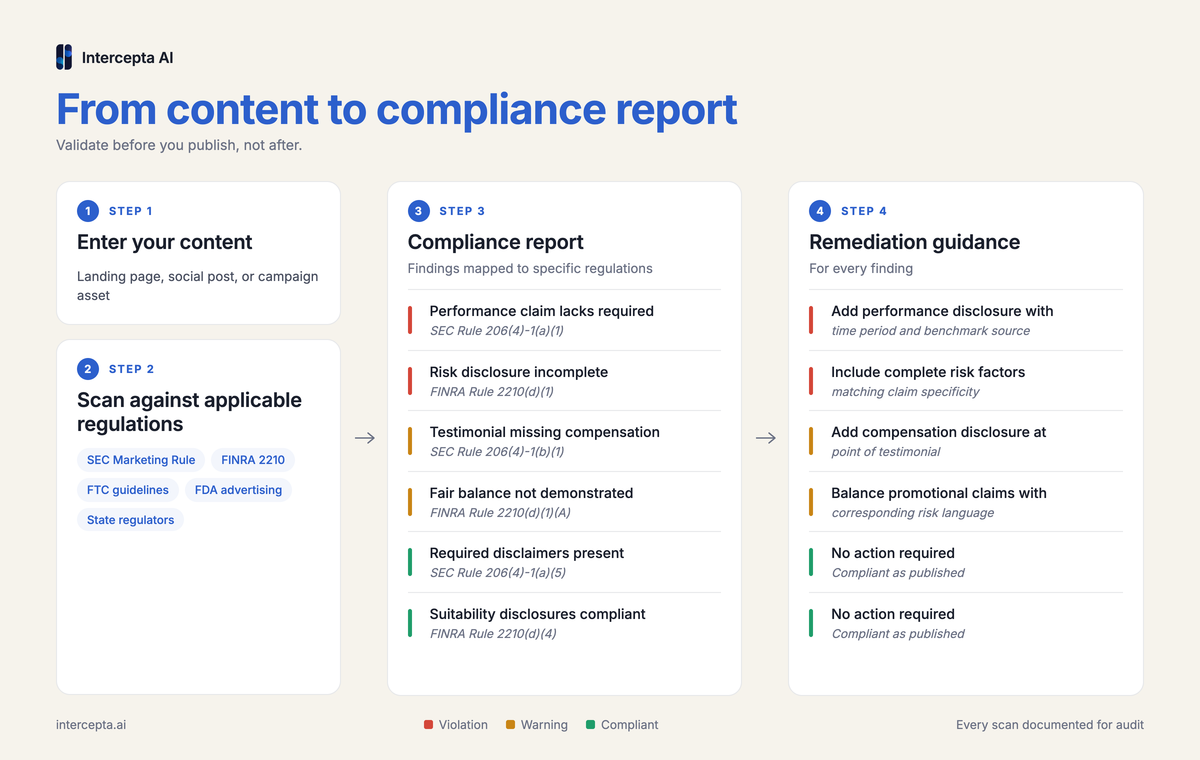
Intercepta AI validates marketing content against current regulations before publication. It maps every finding to the specific regulation, cites the requirement, and gives guidance on how to bring it into compliance. When regulations change, it automatically re-validates everything that is already live or archived.
The platform covers social media posts, email campaigns and variants, blog articles, landing pages, website content, PDFs, and assets stored in Digital Asset Management and Content Management systems. It is designed for marketing teams in regulated industries, not as another dashboard for the compliance officer to log into, but as a compliance layer embedded directly in the content workflow.
Intercepta AI gives marketing teams the ability to validate content against current regulations before publication, giving compliance teams a documented record of every scan.
When a regulation updates, Intercepta AI does not wait for someone to request a new review. It re-scans every connected asset against the new requirement automatically. Every finding is mapped to the rule it violates, with a citation and guidance on how to bring the content into compliance.
Intercepta AI does not replace the compliance review. It sits inside the workflow alongside the compliance professionals, so they spend less time finding violations and more time making decisions.
The 24% problem
The urgency extends beyond today's volume. The same Ncontracts survey found that 24% of financial institutions expect up to a quarter of their compliance staff to retire within five years. The teams responsible for reviewing marketing content are shrinking while the volume of content they need to review continues to grow.
Intercepta AI was built for this structural reality. Not for a world where compliance teams have unlimited capacity, but for the world that actually exists, where two people are responsible for reviewing everything a marketing team of twenty produces.
The enforcement context
The regulatory environment has shifted decisively toward larger, more consequential penalties. The SEC collected $8.2 billion in financial remedies in FY2024, the highest in its history. FINRA brought 552 disciplinary actions in 2024, a 22% increase from the prior year, and started naming individuals, not just firms (Eversheds Sutherland, 2024). The 2025 sanctions total confirmed the trend.
The penalties are getting larger, not smaller. The question is no longer whether your marketing content is compliant. It is whether you can prove it.
Try Intercepta AI
Gauge where your content stands against current regulations. Run your first three scans, on us.
Sources:
- Eversheds Sutherland, 2025 FINRA Sanctions Study, April 2026
- Eversheds Sutherland, 2024 FINRA Sanctions Study, March 2025
- Ncontracts, The Future of Compliance: Benchmarking the People, Processes, and Pressures Shaping Compliance in 2026 (n=183)
- FINRA, Robinhood Financial LLC disciplinary action, March 2025
- SEC Annual Enforcement Results, FY2024