Compliance Validation Before Delivery: What Agencies Serving Regulated Industries Need to Know
If your agency delivers content to clients in regulated industries, every asset you produce is subject to the same regulatory requirements as content the client creates in-house.
The Financial Conduct Authority (FCA) in the UK states that firms remain responsible for every financial promotion published on their behalf, including content created by third-party agencies (FCA Finalised Guidance FG24/1, March 2024). The Canadian Securities Administrators (CSA) warned in December 2025 that firms may face enforcement action for content published on their behalf by third parties, even if violations are unintentional (CSA/CIRO Joint Staff Notice 31-369). In the US, the Financial Industry Regulatory Authority (FINRA) reaffirms in its 2026 Regulatory Oversight Report that firms cannot outsource their regulatory obligations, including when using third-party vendors.
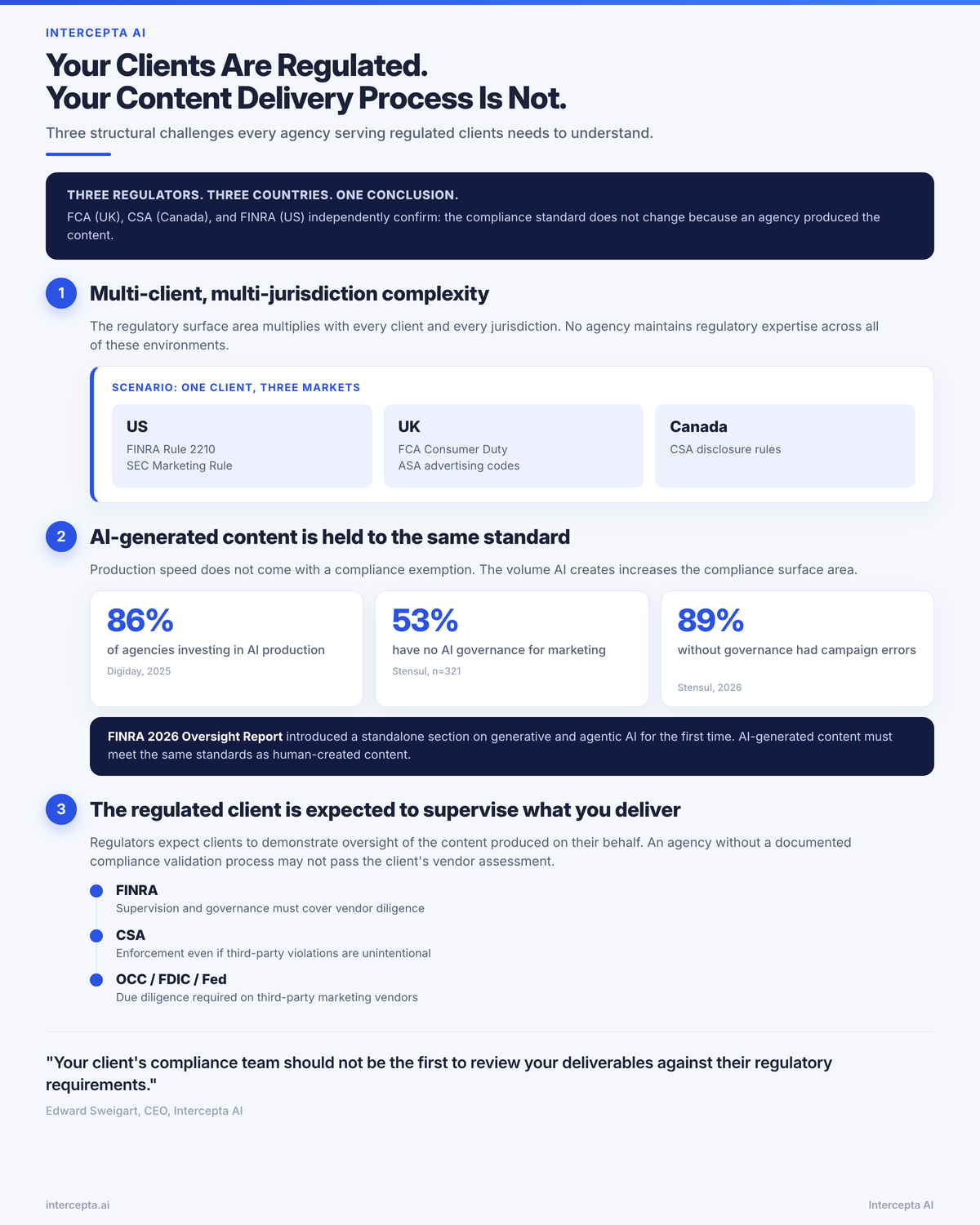
Three regulators in three countries arrived at the same conclusion independently: the compliance standard does not change because an agency produced the content. The principle is not limited to these jurisdictions. It is the direction regulated markets are moving globally.
This blog examines three structural challenges agencies face when delivering content to clients in regulated industries, and how compliance validation before delivery addresses each one.
1. Multi-client, multi-jurisdiction complexity
An agency serving a single regulated client in a single market can learn the regulatory framework over time. An agency serving multiple regulated clients across multiple markets cannot. The regulatory surface area multiplies with every client and every jurisdiction.
Consider an agency running a product launch for a financial services client expanding into three markets. The US campaign must comply with FINRA Rule 2210 and SEC Marketing Rule requirements. The UK version must meet FCA Consumer Duty standards and ASA advertising codes. The Canadian materials must satisfy CSA disclosure rules. The messaging is adapted for each market. The regulatory requirements are entirely different in each one. The agency is delivering all three.
No agency maintains regulatory expertise across all of these environments. Agencies are hired for creative and strategy. The regulatory knowledge sits with the client's compliance team, but the content is produced by the agency, often weeks before the compliance team sees it.
For agencies, the governance gap is compounded by the jurisdictional gap. The agency does not just lack governance for one regulatory framework. It lacks governance for every framework its clients operate under. PwC's 2025 Global Compliance Survey found that half of compliance professionals have a global remit and must navigate different laws and regulations across multiple jurisdictions (PwC, 2025). For agencies delivering content on behalf of these organisations, the jurisdictional complexity is inherited with every client relationship.
2. AI-generated content is held to the same standard
Agencies are adopting AI at speed. Digiday's 2025 survey of 142 brand and agency professionals found that 86% are now investing in AI and 72% are using it for copy generation (Digiday, Q4 2025). Production volume has scaled. The compliance validation has not.
The Stensul 2026 MarTech Governance Outlook surveyed 321 US and UK marketing technology decision-makers and found that 53% of organisations have no comprehensive AI governance for marketing campaign creation. 44% report that AI adoption has increased compliance or brand risk. Among organisations without that governance, 89% experienced at least one campaign error in 2025, compared to 44% across all organisations surveyed (Stensul, n=321, March 2026).
FINRA's 2026 Regulatory Oversight Report, published in December 2025, introduced a standalone section on generative and agentic AI for the first time. The report is explicit. AI-generated content must meet the same standards as human-created content. All communications must be fair and not misleading, including content from generative AI-powered channels. Firms are expected to ensure that their supervision and governance practices cover AI use cases, model risks, and fair and balanced customer communications.
For agencies, this means every piece of AI-generated content delivered to a client in a regulated industry is subject to the same compliance review as content written by a human copywriter. The production speed that AI enables does not come with a compliance exemption. If anything, the volume AI creates increases the compliance surface area; more content is produced across more channels, and each piece is subjected to the same regulatory requirements.
The FCA's guidance reinforces this. FG24/1 does not distinguish between content the firm created internally, and content created by a third-party agency or an AI tool. The firm is responsible for every financial promotion it causes to be made. The method of production is irrelevant to the compliance obligation.
3. The regulated client is expected to supervise what the agency delivers
The third structural challenge is the one most agencies underestimate. The regulatory framework does not just hold the client responsible for content published on their behalf. It expects the client to supervise the process that produced it.
FINRA's 2026 Oversight Report states that firms should ensure their supervision and governance practices cover vendor diligence and the capture of AI-enabled communications within firm books and records. The obligation goes beyond the content itself. The client must prove they had a supervisory process in place to review what the agency delivered.
The CSA's December 2025 Joint Staff Notice makes this even more pointed. The notice warns that firms may face enforcement action for content published on their behalf by third parties, even if violations are unintentional. The word "unintentional" is the critical detail. The agency may not have been aware of a regulatory change. The client still faces enforcement.
In the US, the Interagency Guidance on Third-Party Relationships (OCC, FDIC, Federal Reserve, June 2023) requires regulated firms to conduct due diligence on third-party vendors, including marketing agencies, and to monitor their performance against compliance requirements. An agency without a documented compliance validation process may not pass the client's vendor assessment.
Regulators across major markets now expect firms in regulated industries to demonstrate oversight of the content produced on their behalf. For instance, in the US, UK, and Canada this expectation is already codified. For agencies, that means compliance validation before delivery is no longer a differentiator. It is a client requirement.
The agencies that build compliance validation into their delivery process give their clients in regulated industries confidence that the content meets current requirements before it reaches the compliance team. The creative work alone does not provide that.
Your client's compliance team should not be the first to review your deliverables against their regulatory requirements.
— EDWARD SWEIGART, CEO, INTERCEPTA AI
Closing the gap: compliance validation before delivery
The three challenges described above share a common root. The agency has no way to validate content against the client's regulatory requirements before delivery. Doing so requires regulatory expertise across every jurisdiction the client operates in, applied to every piece of content the agency produces, updated every time the regulations change. That capability needs to be built into the delivery process, not bolted on after.
Intercepta AI was built to sit in that gap. The scanner validates content against the regulatory requirements that apply to the client's industry and jurisdiction before the agency delivers it. Every finding cites the specific rule it violates with remediation guidance. The compliance team still makes the final determination, but the agency gives them work that is ready for review on arrival.
For agencies serving clients across multiple jurisdictions, the scanner covers US federal and state regulations, UK post-Brexit requirements, EU rules, and Canadian securities standards. A single campaign going live across borders is validated against the regulations in each market it reaches, not the market the agency sits in.
The agency does not need to be a compliance expert in every jurisdiction. The scanner is.
What this means for agencies
The competitive landscape for agencies is shifting. A 2025 survey of marketing leaders found that a majority have reduced agency spend as AI-driven content production scales (Typeface, n=200+, October 2025). For agencies serving clients in regulated industries, the differentiator is not production speed. It is confidence that the content meets the client's regulatory requirements before delivery.
If your agency delivers content to clients in regulated industries, gauge where that content stands against current regulations. Your first three scans are on us.
Sources
- FINRA 2026 Annual Regulatory Oversight Report (December 2025; AI-generated content held to same standard as human-created content; first standalone section on generative and agentic AI; supervision expectations for vendor diligence and AI-enabled communications)
- FCA Finalised Guidance FG24/1: Financial Promotions on Social Media (March 2024; firms responsible for every financial promotion they cause to be made, including content by third-party agencies)
- CSA/CIRO Joint Staff Notice 31-369 (December 2025; firms may face enforcement for third-party content even if violations are unintentional)
- Digiday+ Research, "The marketer's guide to AI applications, agentic AI, AI search and GEO/AEO in 2026" (n=142 brand and agency professionals, Q4 2025; 86% AI investment, 72% copy generation)
- Stensul, "The MarTech Governance Outlook: Campaign Creation, AI Adoption and Risk" (n=321 US and UK marketing technology decision-makers, March 2026; 53% no comprehensive AI governance, 44% increased compliance/brand risk, 89% without governance experienced campaign errors vs 44% baseline)
- Typeface/Advertising Week NYC survey (n=200+ marketing leaders VP+, October 2025; 60% decreased agency spend due to AI)
- PwC Global Compliance Survey 2025 (half of compliance professionals have a global remit navigating regulations across multiple jurisdictions; 85% report compliance requirements more complex in past three years)
- Interagency Guidance on Third-Party Risk Management (OCC, FDIC, Federal Reserve, June 2023; due diligence and monitoring of third-party vendors including marketing agencies)